
What is gemm? A detailed explanation of high-performance matrix multiplication acceleration solutions that every AI industry should know.
GEMM(General matrix multiplication) isAIScientific computing field“"Performance Engine"”,Most core computations in deep learning and big data algorithms rely on GEMM.Highly efficient GEMMs not only support critical tasks such as model training, inference, and recommendation, but also have a profound impact on the architectural design of CPUs, GPUs, and even AI chips. This article provides a detailed overview of GEMM principles, applications, mainstream high-performance implementations (OpenBLAS, cuBLAS, BLIS, CUTLASS, etc.), and automatic fusion scheduling tools, supplemented by multi-platform testing, optimization tips, and a developer FAQ, offering a one-stop performance selection guide for AI engineers, decision-makers, and developers.
What is GEMM? Why is it the cornerstone of AI and scientific computing?
GEMM definition and its basic mathematical form
GEMM (General Matrix-Matrix Multiplication) is one of the most fundamental and frequently used operations in linear algebra. Its general form is:C = αAB + βC
in A, B, C All are matrices, with α and β being scalars. In most AI scenarios, this is simplified to... C = AB。
GEMMWidely used in various deep learning networks (such as
Transformer、CNNLarge-scale recommendation systems, scientific simulations, and physical engineering modeling are the real computational bottlenecks for AI algorithms.
- Time complexity:
O(MNK) - Space complexityApproximately equal to
O(MK + KN + MN)
When the matrix dimension is 1024 or higher, the computational scale can reach...Billion-level floating-point operationsTherefore, AI chips and servers are all built around GEMM acceleration units.
Recommended reading:Detailed Algorithm Analysis - GEMM Optimization Principles
GEMM's core position in the AI industry
- Deep learning frameworks (PyTorch, TensorFlow) primarily use high-performance GEMM for underlying matrix operations.
- NLP and CV models perform tens of thousands of large matrix operations every day.
- AI chips, FPGAs, and supercomputers all have specially designed GEMM hardware acceleration modules.
- The performance of GEMM directly determines the efficiency of model training and inference.
A comprehensive overview of mainstream high-performance GEMM solutions and tools
| name | type | Applicable Hardware | Optimization features | Official website/link |
|---|---|---|---|---|
| OpenBLAS | open source library | CPU/X86/ARM | Multithreading/Matrix Blocking | OpenBLAS |
| Intel MKL | Commercial Library | Intel CPU/X86 | Vectorization/SIMD | oneAPI MKL |
| cuBLAS | Commercial Library | NVIDIA GPU | Tensor Core/FMA | cuBLAS |
| CUTLASS | Open source tool library | NVIDIA GPU | Highly configurable/AI optimized | CUTLASS |
| BLIS | open source library | CPU/X86/ARM | Multi-level partitioning/scalable | BLIS |
| Eigen | C++ library | Cross-platform CPU | Templated/Automatic Vectorization | Eigen |
| cblas/sgemm/dgemm | BLAS Standard | General purpose CPU | Standard API | BLAS Introduction |
| TVM/ONNX Runtime/TensorRT | frame | CPU+GPU+AI Chip | Automatic Search and Fusion Scheduling | TVM |

Note: Currently, the underlying GEMM of mainstream AI frameworks heavily relies on the aforementioned libraries. PyTorch and TensorFlow typically provide secondary encapsulation, so whenever the library's performance is upgraded, the AI model directly benefits.
High-performance GEMM implementation and optimization on CPU platform
BLAS Standard API and Commonly Used Interfaces
// sgemm/dgemm classic calling example (C/C++) void cblas_sgemm(const CBLAS_LAYOUT Layout, const CBLAS_TRANSPOSE TransA, const CBLAS_TRANSPOSE TransB, const int M, const int N, const int K, const float alpha, const float *A, const int lda, const float *B, const int ldb, const float beta, float *C, const int ldc);sgemmSingle precision (float)dgemmDouble precision
This interface is compatible with all mainstream AI and scientific computing software.
A horizontal comparison of mainstream CPU GEMM libraries
| 库 | Optimization methods | Multithreading | Vector instructions | Remark |
|---|---|---|---|---|
| OpenBLAS | Cache segmentation + SIMD + threads | √ | AVX512/AVX2/NEON | Community activity |
| Intel MKL | AVX512 manual optimization | √ | AVX512 | Optimal for Intel Platform |
| BLIS | Pluggable/Multi-core | √ | AVX/NEON | AMD/ARM are also highly efficient |
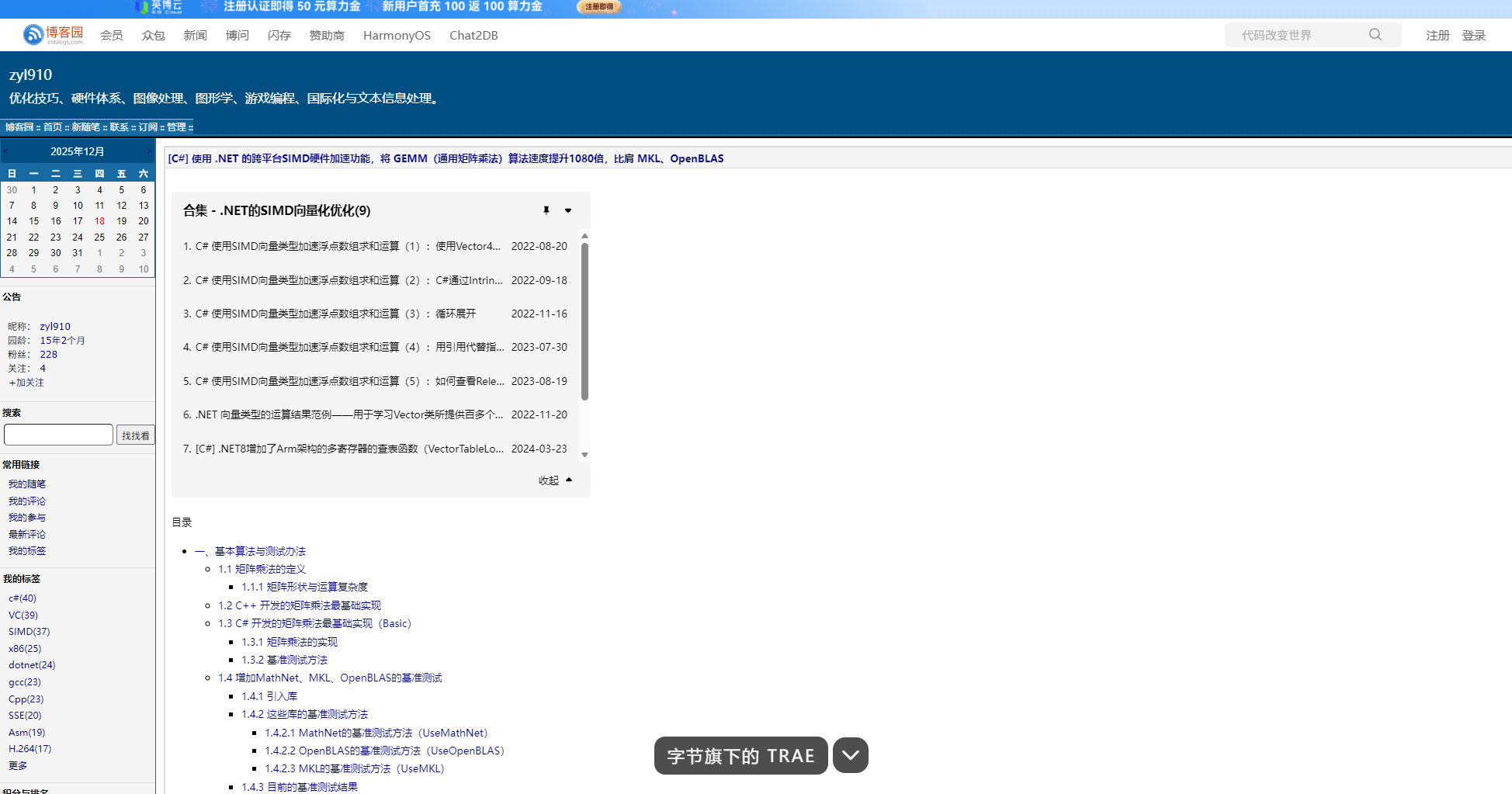
| MathNet (.NET) | Managed code + basic SIMD | limited | .NET SIMD | Cross-platform, medium speed |
| Eigen | Automatic template vectorization | × | Supports automatic SIMD | C++ compatibility is preferred; slightly slower for very large scale applications. |
Measured baseline data (1024×1024 SGEMM, single node)
| accomplish | Time taken (ns) | Relative performance | GFLOPS |
|---|---|---|---|
| Triple loop C++ | 4,712,905,103 | 1x | 0.42 |
| OpenBLAS | 2,932,070 | 1607x | 682 |
| Intel MKL | 4,379,927 | 1076x | 456 |
| MathNet | 53,205,723 | 88x | 37.5 |
| SIMD+ Block Parallelism (C#) | 4,363,112 | 1080x | 458 |
More data sources:C# .NET Class Library High Performance Comparison
CPU optimization techniques
- Loop unrolling and reordering improve cache/VPU locality.
- Cache segmentation (L2/L3) reduces memory bandwidth pressure
- SIMD instruction optimization (SSE/AVX/NEON)
- Multi-core parallelism (OpenMP/PThread)
- Fusion Multiply-Accumulate FMA Instructions
List of mainstream CPU GEMM library addresses:
High-performance GEMMs on GPUs and AI chips
Mainstream NVIDIA/AMD GPU libraries
| library name | platform | optimization | use | Official website |
|---|---|---|---|---|
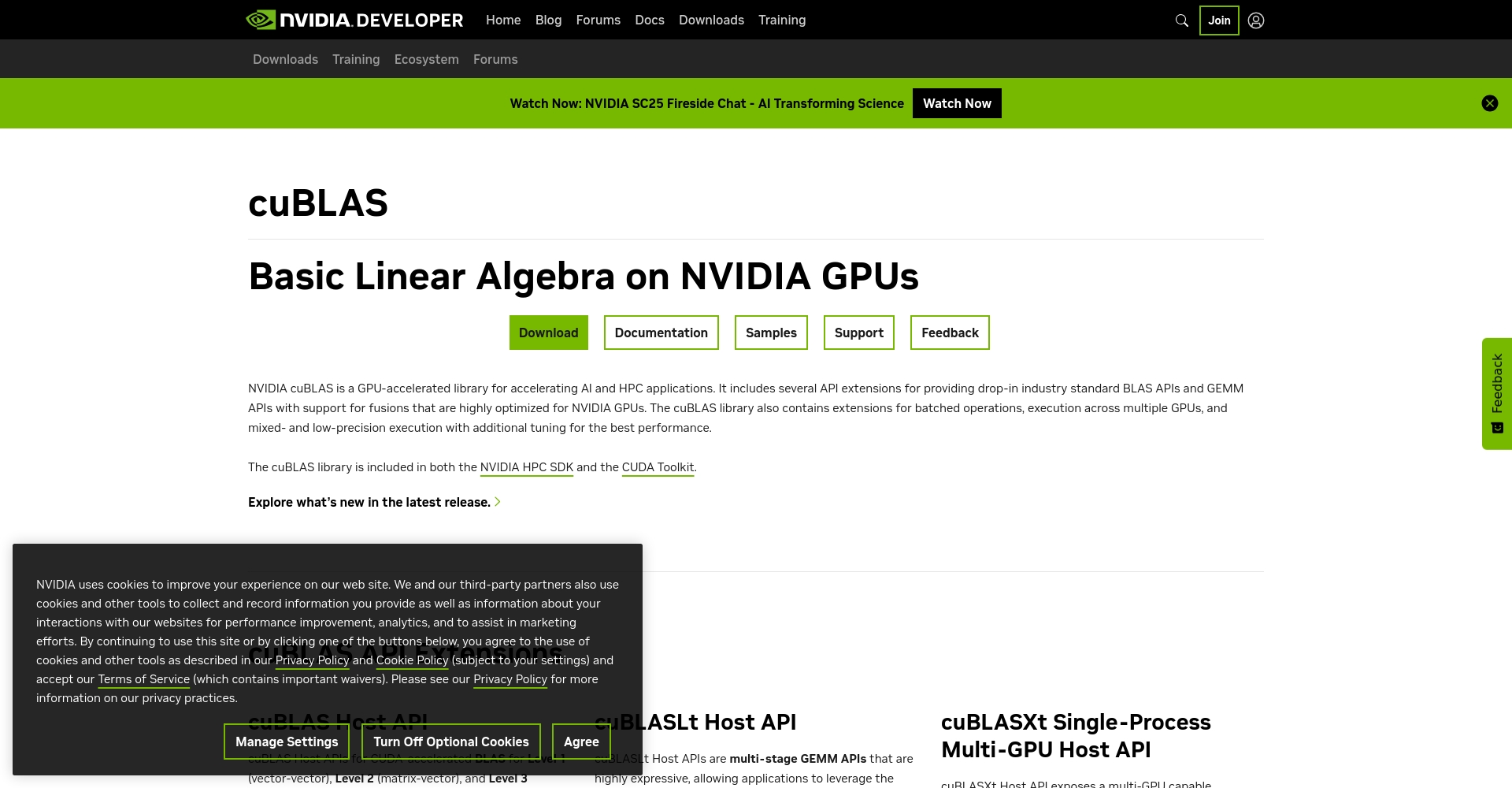
| cuBLAS | NVIDIA | Tensor Core/FMA | Training/Inference | cuBLAS |
| CUTLASS | NVIDIA | Template customization | Self-developed Kernels | CUTLASS |
| ROCm BLAS | AMD | The platform targets | AMD Training/Inference | ROCm BLAS |
| TensorRT/ONNX | Multi-platform | Automatic fusion/INT8 | Inference Engine | TensorRT |
- cuBLAS/ROCmIt is a mainstream training engine that supports FP32, FP16, and BF16 mixed precision GEMM.
- NVIDIA Tensor Cores and AI chips both feature dedicated GEMM circuitry for ultimate performance.
Recommended reference:NVIDIA cuBLAS documentation | CUTLASS tutorial
AI framework and automated GEMM fusion scheduling
Framework native GEMM support list
| frame | rely | Automatic fusion | hardware |
|---|---|---|---|
| PyTorch | MKL/OpenBLAS/cuBLAS | Dynamic scheduling | CPU/GPU/AI chips |
| TensorFlow | MKL/OpenBLAS/cuBLAS | Automatic fusion | CPU/GPU/TPU |
| ONNX Runtime | Multi-platform | TVM scheduling | Multiple hardware |
| PaddlePaddle | MKL/Self-developed | CUDA/AI chip support | Multi-platform |
- The TensorFlow/Torch to ONNX converter, via TensorRT/ONNX Runtime, can automatically select the optimal GEMM implementation.Developers do not need to concern themselves with the underlying details.
Mainstream automatic fusion tools
- TVMAutomatic Kernel search for optimal GEMM
- OneDNNIntel Automated Optimization Fusion
- TorchDynamoPyTorch Dynamic Kernel
- TensorRTNVIDIA Inference Fully Automated Optimization
GEMM Performance Optimization Engineering Examples
Swapping Loop Order and Blocking (C++ Practice)
// Naive version of for (int i = 0; i < N; ++i) for (int j = 0; j < N; ++j) for (int k = 0; k < N; ++k) C[i][j] += A[i][k]*B[k][j]; // Rearrangement optimization for (int i = 0; i < N; ++i) for (int k = 0; k < N; ++k) { float a = A[i][k]; for (int j = 0; j < N; ++j) C[i][j] += a * B[k][j]; }After the rearrangement, the access locality of B/C is improved, and the speedup of Cache and SIMD is significant.
Segmentation Strategy and Platform Applicability (Illustrated Table)
| Blocking strategy | advantage | Applicable Platforms |
|---|---|---|
| L2/L3 partitioning | High cache hit rate | CPU |
| Tile+SIMD | Alignment vectors, pipeline | CPU/GPU |
| Thread Blocking | parallel | Multi-core CPU/GPU |
| TensorCore specific blocks | AI chip extreme performance | NVIDIA GPU/AI chip |
Brief Introduction to FPGA and AI Chip GEMM Acceleration Solutions
- Large-scale GEMM array (Mult/Accumulate cell)
- Supports variable precision (INT8/BF16/F16), with computing power in the hundreds or thousands of TFLOPS.
- Domestic AI chips such as Ascend have dedicated GEMM cores.
Developer FAQs and Selection Recommendations
How to choose GEMM libraries for different platforms?
- CPU (x86/AMD)OpenBLAS and BLIS are preferred; MKL is an option for Intel platforms.
- GPUNVIDIA uses cuBLAS, AMD uses rocmBLAS
- Embedded/ARMIt is recommended to use lightweight implementations such as Eigen.
- .NET/JavaPrioritize external calls to the BLAS library.
- AI chip/FPGARecommended solution using the official SDK
Does the performance meet the standards?
- A 1024×1024 large matrix can achieve >20 GFLOPS in a single-threaded operation and >1000 GFLOPS in a multi-threaded or GPU-based operation.
- Make good use of perf/nvprof/ncu/VTune to analyze bottlenecks
- The data arrangement format has a significant impact; it is recommended to match the default format of the database.
Conclusion
GEMM is the driving force behind the AI technology stack.Its impact is far-reaching.High-efficiency GEMM solutions such as OpenBLAS, cuBLAS, and BLIS are constantly innovating and evolving, and the new generation of AI chips is also accelerating its development in this module, leading the AI industry to a new level.
Understanding and utilizing the latest GEMM optimization solutions can not only ensure system performance but also give you a head start in AI business innovation.
Further technical references:BLAS Official | oneMKL | cuBLAS | OpenBLAS
© Copyright notes
The copyright of the article belongs to the author, please do not reprint without permission.
Related posts



No comments...