
FP8 In-Depth Analysis: A High-Efficiency, Low-Power New Choice in the AI Computing Era; How Can Developers Avoid Core Performance Pitfalls?
- FP8 (8-bit floating-point) low-precision format has becomeAIThe best choice for high computing power and low energy consumptionIt is gradually being natively supported by chips from NVIDIA, AMD and other manufacturers.
- Detailed analysis of the articleThe principles, advantages and risks of FP8Compared with mainstream formats such as BF16, FP16, FP32, and INT4.
- supplyPractical solutions for implementing mixed-precision training projects and a list of pitfalls to avoid.This helps developers avoid performance and convergence pitfalls.
- This article reviews the latest applications and tools of FP8 in mainstream large models and industry chains, both domestically and internationally.
- This article will enable developers to master practical methods for efficient FP8 deployment and risk tuning.This will help large-scale models achieve high-quality and low-cost deployment.
The computing power bottleneck under the rapid development of AI and the rise of FP8
With the accelerated development of large-scale AI models and deep learning, the entire industry is facing a double "anxiety" regarding computing power and energy consumption.How can we maximize hardware efficiency and reduce training and inference costs while maintaining model capabilities? FP8 (8-bit floating-point)It is becoming a "new favorite" among AI companies and developers. Its advantages and potential risks are being widely discussed, with leading chip manufacturers such as...NVIDIA Hopper architectureBoth AMD MI300 and AMD MI300 natively support the FP8 format, propelling the AI industry into a new era of greater efficiency and economy.
Comparison of FP8 and mainstream data precision formats
Data Format Overview
| Format | Bit width | accuracy | Dynamic range | performance | Main application scenarios |
|---|---|---|---|---|---|
| FP8 | 8 | Low-medium | Medium-high | Extremely high | Inference, Mixed Precision Training |
| BF16 | 16 | medium | 高 | 高 | Large model training |
| FP32 | 32 | Highest | Extremely high | 低 | Scientific computing, refined training |
| INT4 | 4 | Extremely low | Extremely low | Extremely high | Extreme Quantization, Edge AI |

FP8 has become a cost-effective option in the race for high-throughput computing power and ultra-low storage requirements.But what it bringsPrecision-sensitive challenges, hardware adaptation, and performance pitfallsIt also tests the engineering skills of the development team.
FP8 In-Depth Principles and Implementation Details
What is FP8? Why is it crucial?
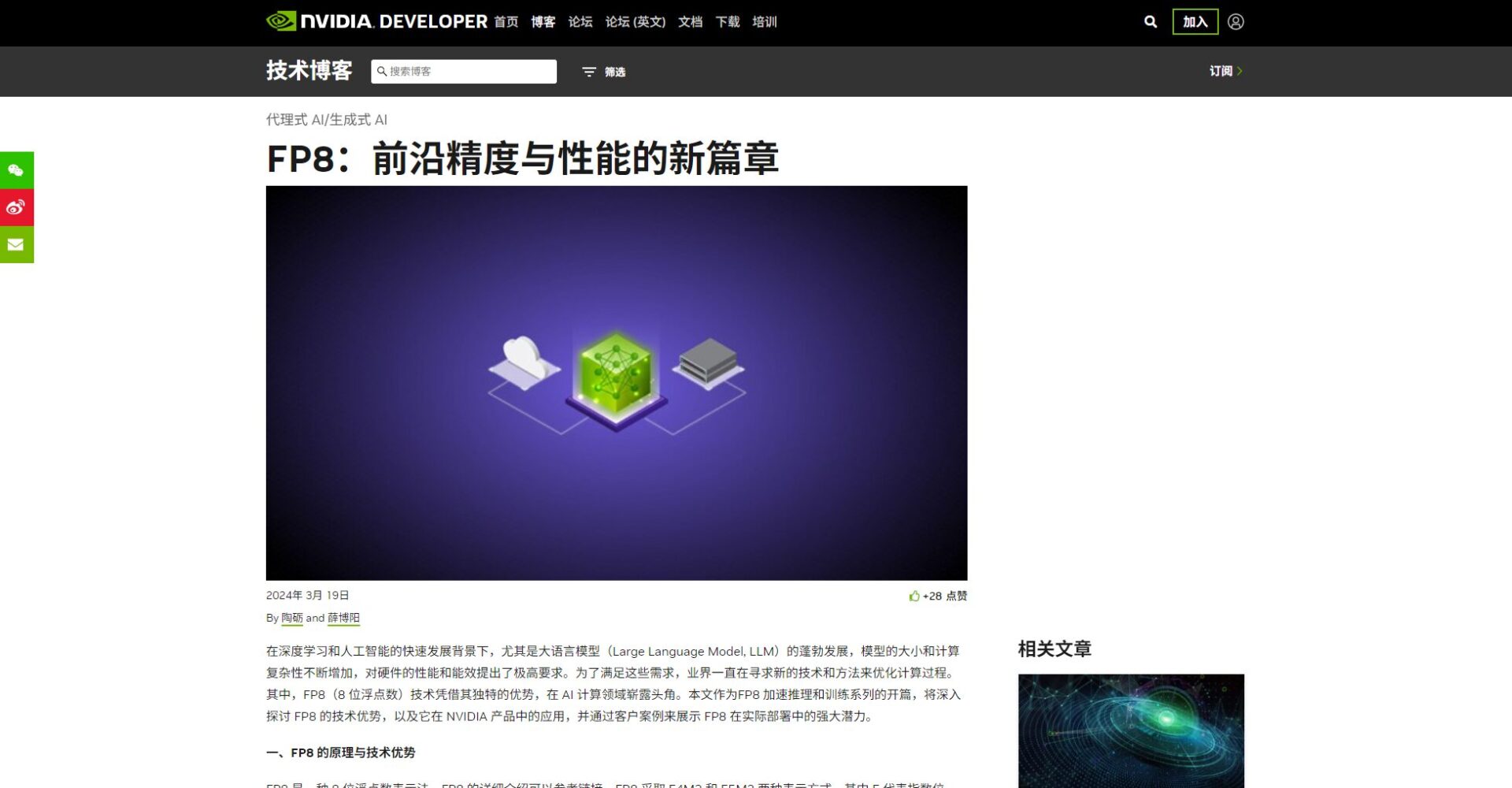
FP8 (8-bit Floating Point)It is a representative of "third-generation AI low-precision training" technology, and classic formats include...E4M3(4-digit exponent, 3-digit last digit) andE5M2(5 exponents, 2 mantissas). Compared to medium-precision formats such as FP16 and BF16, FP8 uses extremely concise storage of 8 bits per parameter, while providing Tensor Core-level acceleration for general deep neural network operations (such as matrix multiplication and convolution).
refer to:https://developer.nvidia.com/zh-cn/blog/fp8-challenges-best-practices/
FP8's main advantages
- Ultra-low memory usageThe parameter storage and communication bandwidth consumption is reduced by half or even a quarter compared to FP16/32, greatly improving server throughput.
- Tensor Core accelerationOn hardware such as NVIDIA Hopper, the throughput of FP8 matrix operations is twice that of FP16, effectively shortening training and inference time.
- Improved inference-training consistencyIf the model is trained using FP8, the inference end can directly inherit the weights, reducing the complexity of the post-quantization logic.
- Energy consumption and cost optimizationIt enables training larger and faster models with the same hardware resources, and is especially suitable for large models such as Transformer and LLM.
Key limitations and risks of FP8
- Numerical stability problemThe mantissa and exponent are significantly reduced, the risk of extreme values and abnormal convergence is significantly increased, and training instability phenomena such as loss spike are more likely to occur.
- Operator and Model SensitivityMethods such as Attention and normalization (LayerNorm, RMSNorm) are extremely sensitive to accuracy, and excessive compression may lead to loss of accuracy and hinder convergence.
- High hardware compatibility requirementsRequires the latest GPU (such as NVIDIA H100, A100 or higher) and a new generation AI training framework that supports FP8 full-link hybrid computing.
- Increased complexity of engineering operation and maintenanceIt requires complex mix precision policies (such as Per-Tensor Scaling, Delayed Scaling, etc.) to achieve reasonable dynamic range control of values, which increases the optimization cost for developers.
Engineering Implementation and Best Practices of FP8 Mixed Precision Training
Mixed Precision Training: O1+O2 Mode
Mixed Precision TrainingThis is a key mechanism for implementing FP8. Mainstream frameworks (PyTorch, TF, etc.) typically support AMP (Automatic Mixed Precision), but more nuanced methods are needed in FP8 scenarios.O1+O2 strategy:
- Whitelist operator FP8 low precisionFor large matrix multiplication (MatMul) and large convolution, FP8 is used.
- High-precision backoff using blacklist operators (BF16/FP32)For example, LayerNorm, Softmax, Embedding, and other processes that require extremely high precision.
- Master Weight Reservation (FP32)To prevent the loss of small gradients, parameter updates retain a full-precision copy.
Dynamic scaling and Delayed Scaling Recipe
- Per-tensor Dynamic ScalingChoose an appropriate scaling factor for each tensor to map the actual value to the FP8 dynamic range and prevent overflow/underflow.
- Historical maximum value estimation (Delayed Scaling): Estimate the current parameter scaling using the maximum Amax value from historical iterations, combining throughput and accuracy.
- Just In Time ScalingIn some extreme scenarios, we attempt to scale in real time to further reduce the number of underflows.
For technical details, please refer to NVIDIA's "Challenges and Best Practices for FP8 Training".“ https://developer.nvidia.com/zh-cn/blog/fp8-challenges-best-practices/
Core optimization and performance trap avoidance

| Risk points | Description/Typical Symptoms | Tips for avoiding pitfalls |
|---|---|---|
| Launch Bound | Excessive Kernel Bubbles, Host-side Launch Overlay | Operator fusion, CUDA Graph merging |
| Synchronous blocking | Frequent host-device synchronization and performance fluctuations | Avoid synchronous operations and batch processing logic |
| FP8 does not support all operators | Special custom operations are not adapted to FP8 | High-precision backoff of important operators |
| Training non-convergence/drift | Loss suddenly increases, gradient explosion/vanishing. | Hybrid precision strategy + hyperparameter tuning, with regular comparison using BF16 reference training. |
| Inconsistent inference/performance degradation | FP8 weights lose precision when directly using BF16/FP16 inference. | The inference end conservatively adopts the BF16/FP8 consistent format. |
- Thoroughly investigate the support for new hardware.Prefer platforms with native FP8 support, such as the Hopper architecture (e.g., H100) and AMD MI300, to avoid older GPUs.
- Combined with PyTorch Transformer Engine: Leveraging its ability to quickly adapt to FP8 and optimize performance, for exampleNVIDIA Transformer Engine。
- Regularly align the convergence path with the BF16 baseline.For example, OpenAI and Meta recommend using BF16 training at regular intervals for comparison to ensure that FP8 training does not experience convergence drift.
- Operator registration and custom compatibility developmentCustom operators for key models need to be adapted separately for FP8, otherwise "black box anomalies" are likely to occur.
Applications of FP8 in practical AI products and communities
Industry Implementation Cases
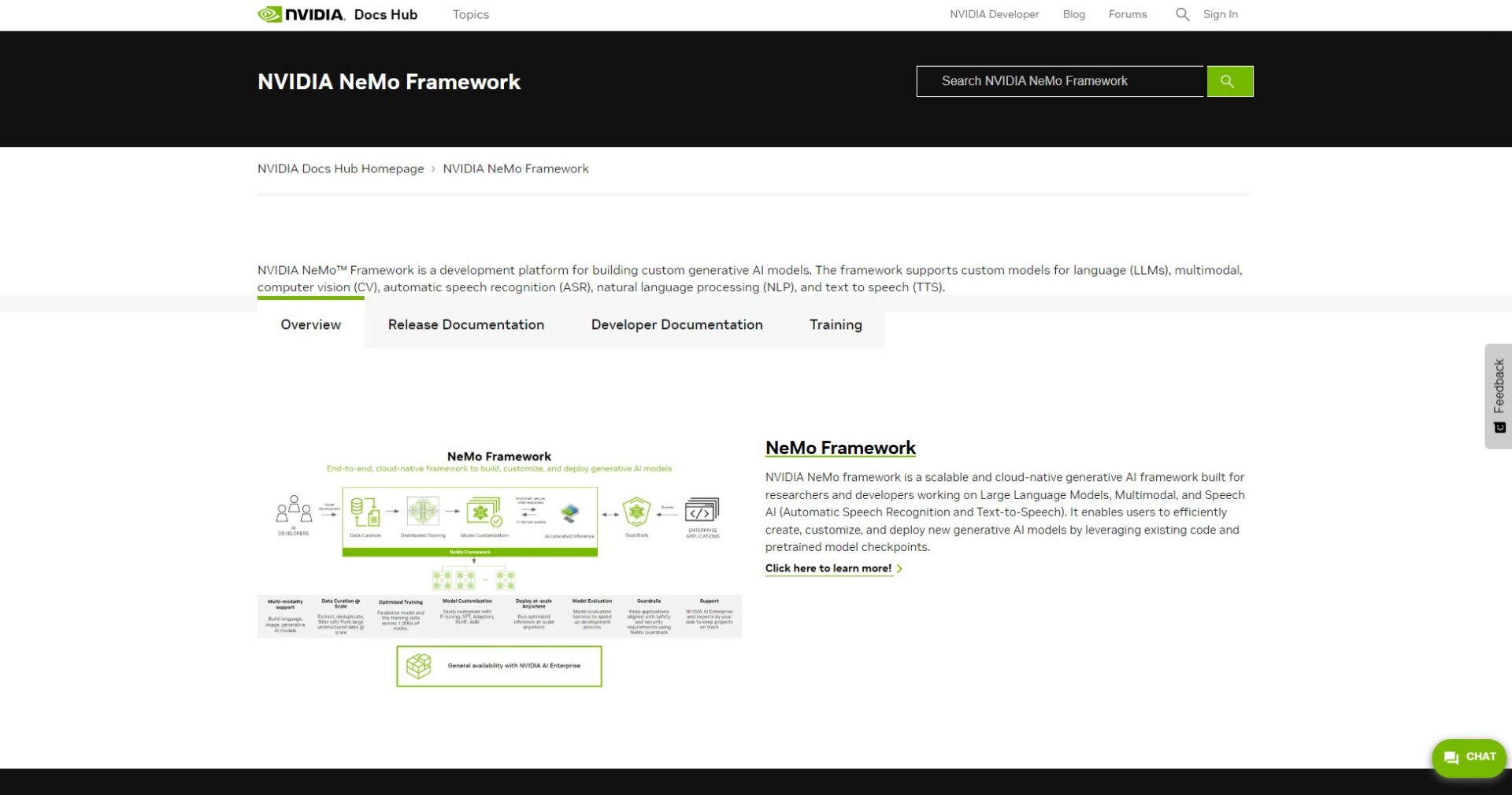
- NVIDIA NeMo LLM frameworkSupports FP8 mixed-precision end-to-end training (see details)NeMo official documentationIt has been applied to mainstream large models such as Llama and Mixtral.
- Large-scale models from domestic manufacturers such as DeepSeek-V2 and ChatGLM3: Large-scale training with FP8 significantly reduces computational costs, and the energy consumption for training 7B/70B models has decreased by double digits, leading to its widespread adoption in the open-source community.
- Large model slimming and integrated inference deploymentThe FP8 training-inference link is shortened, reducing the loss and tuning time during INT4 quantization.
Recommended tools and resources
| name | Brief | Tool links |
|---|---|---|
| NVIDIA Transformer Engine | FP8/BF16/FP16 Mixed Precision Component Library | GitHub |
| NVIDIA NeMo Framework | End-to-end large model training and inference solution | Official website |
| HuggingFace Transformers | Community-led LLM Transformer implementation | Official website |
| PyTorch AMP | Automatic mixed-precision training natively supported | PyTorch AMP documentation |
| DeepSpeed | Open source for distributed and mixed-precision optimization of ultra-large models | DeepSpeed |
Developer's "Troubleshooting Checklist": How to Use FP8 Safely and Effectively?
Common Developer Questions and Solutions
| Scene | Potential problems | Recommended approach |
|---|---|---|
| First time training with a large FP8 model | The model loss is unstable, and the accuracy decreases. | Following the official AMP hybrid strategy, the Master Weight is retained, hyperparameters are optimized, and Delayed Scaling is enabled. |
| Custom module FP8 adaptation | LayerNorm, Softmax, etc. errors | For modules requiring high precision, use BF16/FP32 for rollback. |
| Distributed training/inference communication | FP8 communication error/performance not improved | Confirmed that the new generation of hardware/network bandwidth is compatible. |
| Deploying Quantized Consistency at the Inference End | Precision loss or inference speed not meeting expectations | Ensure that FP8/Per-tensor Scaling is also enabled on the inference end. |
| Exception debugging is difficult to locate | Crashes, gradient explosion/vanishing, performance bubbles | Enable BF16/FP32 reference comparison, analyze using CUDA Graph and Profiler, and follow the NVIDIA guidelines. Performance tuning recommendationsTuning |
End
The arrival of FP8 represents a new balance between AI computing power and engineering trends, and is especially revolutionary for the implementation of large model scenarios such as LLM, AIGC, and RAG.It is both the "golden key" to the popularization of AI and cost reduction and efficiency improvement, and it also hides the double pitfalls of engineering implementation, performance optimization and inference consistency.While developers pursue the limits of computing power, they must also prioritize performance monitoring and accuracy convergence alignment, and continuously absorb industry best practices and new tool ecosystems. The professional implementation of FP8 is a significant watershed moment in the progress of the AI industry, worthy of exploration and learning by all AI practitioners.
For further information on FP8 training practices, best tools, and NVIDIA official documentation, please visit [website address].NVIDIA Developer Blog
© Copyright notes
The copyright of the article belongs to the author, please do not reprint without permission.
Related posts




No comments...