Woebot Health
Woebot Health is a digital therapy platform that uses AI conversational technology to provide users with 24/7 mental health support.
ResearchGPT is an open-source AI academic paper assistant that supports PDF uploading, intelligent question answering, and literature tracing, helping scholars read and conduct research efficiently.
 ResearchGPT
ResearchGPT is a new generationOpen source academic paper AI assistantYou can upload PDF documents and comment on the paper content.Intelligent semantic retrieval and conversational question answeringIt accurately identifies and cites sources. Completely free, it relies on the OpenAI API and is suitable for various scenarios such as scientific research, teaching, and development. Its biggest advantages lie in efficient content screening, transparent source tracing, easy local deployment, and free secondary development, improving the efficiency of academic material search and understanding for university teachers, students, researchers, and developers.
With the continuous evolution of artificial intelligence,Academic research is undergoing a disruptive transformation. ResearchGPT, as a representative of open-source AI paper-writing assistants, is...(GitHub linkResearchGPT has become a hot topic among researchers, university faculty and students, and developers worldwide. Through deep learning technology, it makes "conversational interaction" between people and research papers more efficient and convenient than ever before. This article will provide a detailed analysis of ResearchGPT's main functions, pricing plans, usage process, target audience, and frequently asked questions, and will showcase the power of this latest AI research tool from multiple perspectives using lists and tables.
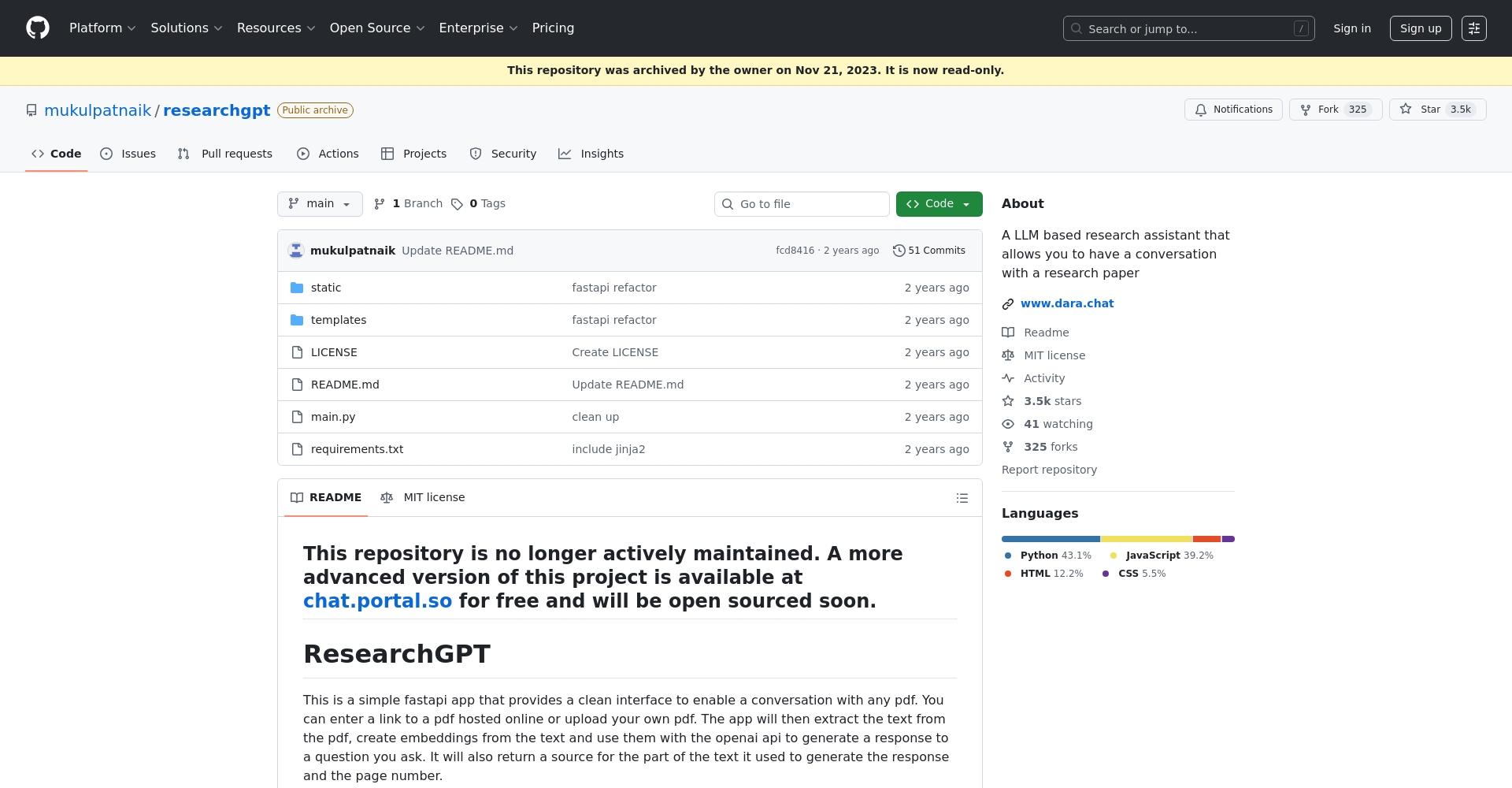
ResearchGPT was developed by Mukul Patnaiopen source developed by kLarge Language Model (LLM) Research Assistant PlatformIt allows users to upload any PDF paper, directly "ask questions," and based on...OpenAI API and Embedding technologyIt automatically retrieves and analyzes the content of papers, and its answers are not only based on full-text intelligent crawling, but also accurately indicate which page and paragraph of the paper the answer is quoted from, ensuring academic rigor and verifiability.Project Homepage。
| Function | illustrate |
|---|---|
| PDF paper upload | Upload a local book/paper PDF or paste the online PDF link. |
| Semantic retrieval | Automatically retrieves paragraphs highly relevant to the question based on embedding. |
| Intelligent Q&A | Generate answers based on the original text by combining OpenAI models. |
| Source mark | Show the page number and paragraph corresponding to the answer. |
| Multi-turn interaction | Supports multiple rounds of follow-up questions |
| Open source and extensibility | The source code is completely open, supporting local/cloud-based secondary development. |
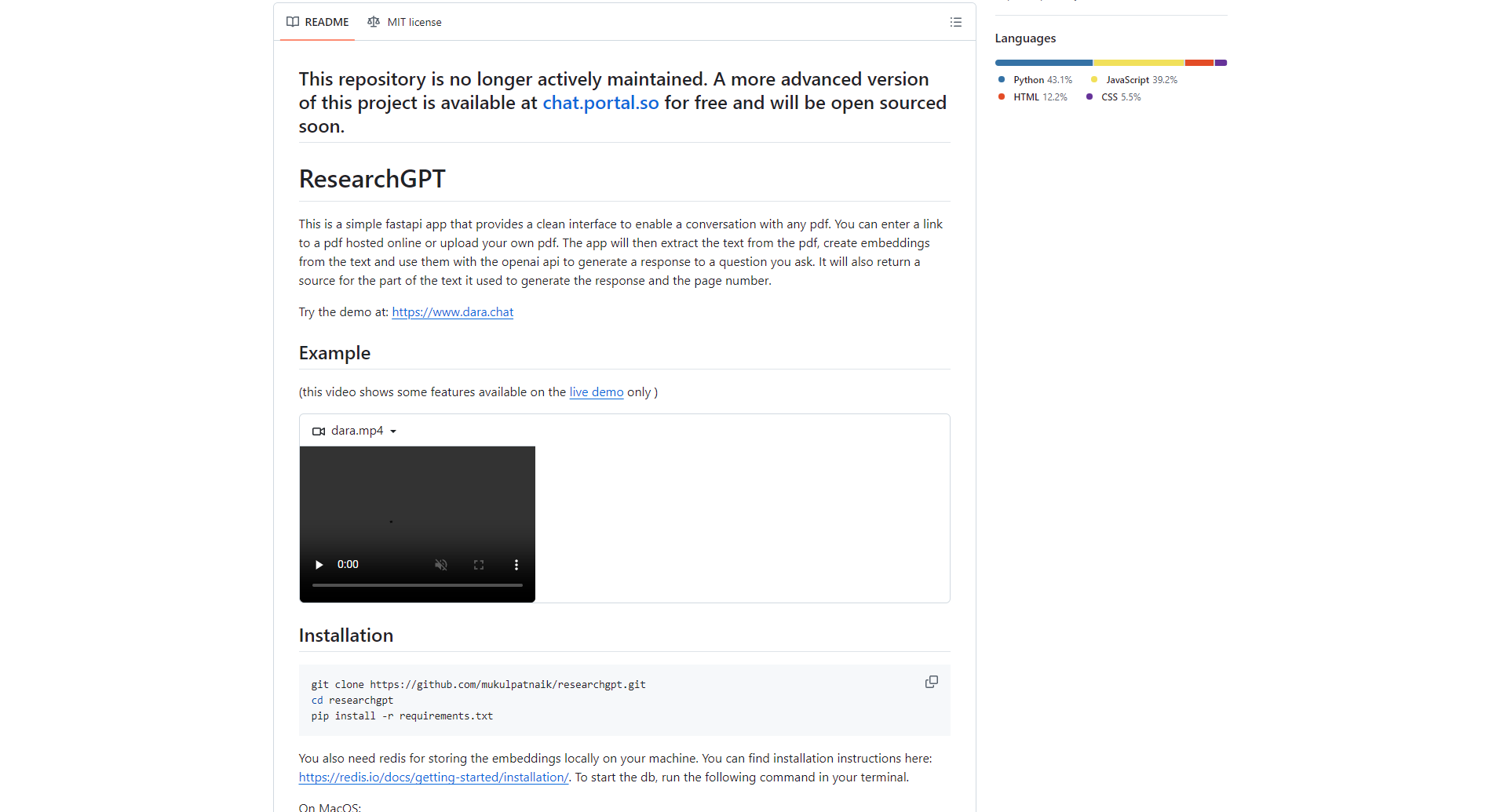

See details Project homepage functionalities。
The ResearchGPT ontology is completely open source and free!Users can download, deploy, and use it for free without paying any feature fees.
However, to achieve AI-powered intelligent understanding and dialogue, you need to prepare your own equipment.OpenAI API Key(Based on OpenAI's official billing), and Redis was chosen as the local embedded storage.
| Scheme type | Is there a fee? | illustrate |
|---|---|---|
| ResearchGPT source code | free | 100% is open source and has no licensing fees. |
| OpenAI API fee | Charged based on usage | You need to apply for an API key yourself, and the fee will be charged according to OpenAI standards. |
| Demo online experience | free | Available dara.chat Online trial |
| Local deployment dependencies | Free/Open Source | Dependencies such as Redis are mainstream open-source projects. |

For more API billing details, please seeOpenAI Official Documentation。
ResearchGPT is easy to deploy and has a friendly learning curve, making it ideal for developers, data scientists, and users with no prior experience to try it out locally.
pip install -r requirements.txtuvicorn main:app --reload| step | Action description |
|---|---|
| Cloning code | git clone https://github.com/mukulpatnaik/researchgpt.git |
| Dependency installation | pip install -r requirements.txt |
| Redis installation | Official documentation |
| Configuration API | Write the API Key to the local environment variable |
| Start service | uvicorn main:app --reload |
| Open browser | accesshttp://localhost:8000Experience |

For more detailed steps, please seeOfficial installation guide。
ResearchGPT is ideal for the following users due to its interactive and scalable features:
| People categories | Application scenario description |
|---|---|
| Graduate/Doctoral Students | Quickly grasp the conclusions and details of the paper |
| Teacher/Mentor | Literature review, lesson preparation materials, and defense materials |
| Enterprise R&D/Knowledge Management | Long report summary, key content retrieval |
| Scientific research self-media | Efficient topic selection and auxiliary literature review organization |
| Components | Function Description |
|---|---|
| FastAPI frontend | File upload, web interaction, issue submission |
| Redis local storage | Fast vector caching improves retrieval speed |
| OpenAI Interface | Using Embedding and LLM to generate answers |
| Open source code | Supports local and cloud-based secondary development |
Riding the wave of artificial intelligence development, ResearchGPT, with its unique positioning of being open-source, powerful, and flexible, is driving the deep intelligentization of the scientific research process. It is not only a powerful tool for scientific literature review, but also a new paradigm for automatic abstracting, direction finding, and deep question answering. For university faculty and students, researchers, and AI developers who want to improve their literature search and analysis, ResearchGPT is undoubtedly an indispensable AI efficiency-enhancing assistant. Log in now!GitHubOr visitOnline DemoExperience it!
This site's AI-powered navigation is provided by Miao.ResearchGPTAll external links originate from the internet, and their accuracy and completeness are not guaranteed. Furthermore, AI Miao Navigation does not have actual control over the content of these external links. As of 6:09 PM on December 8, 2025, the content on this webpage was compliant and legal. If any content on the webpage becomes illegal in the future, you can directly contact the website administrator for deletion. AI Miao Navigation assumes no responsibility.