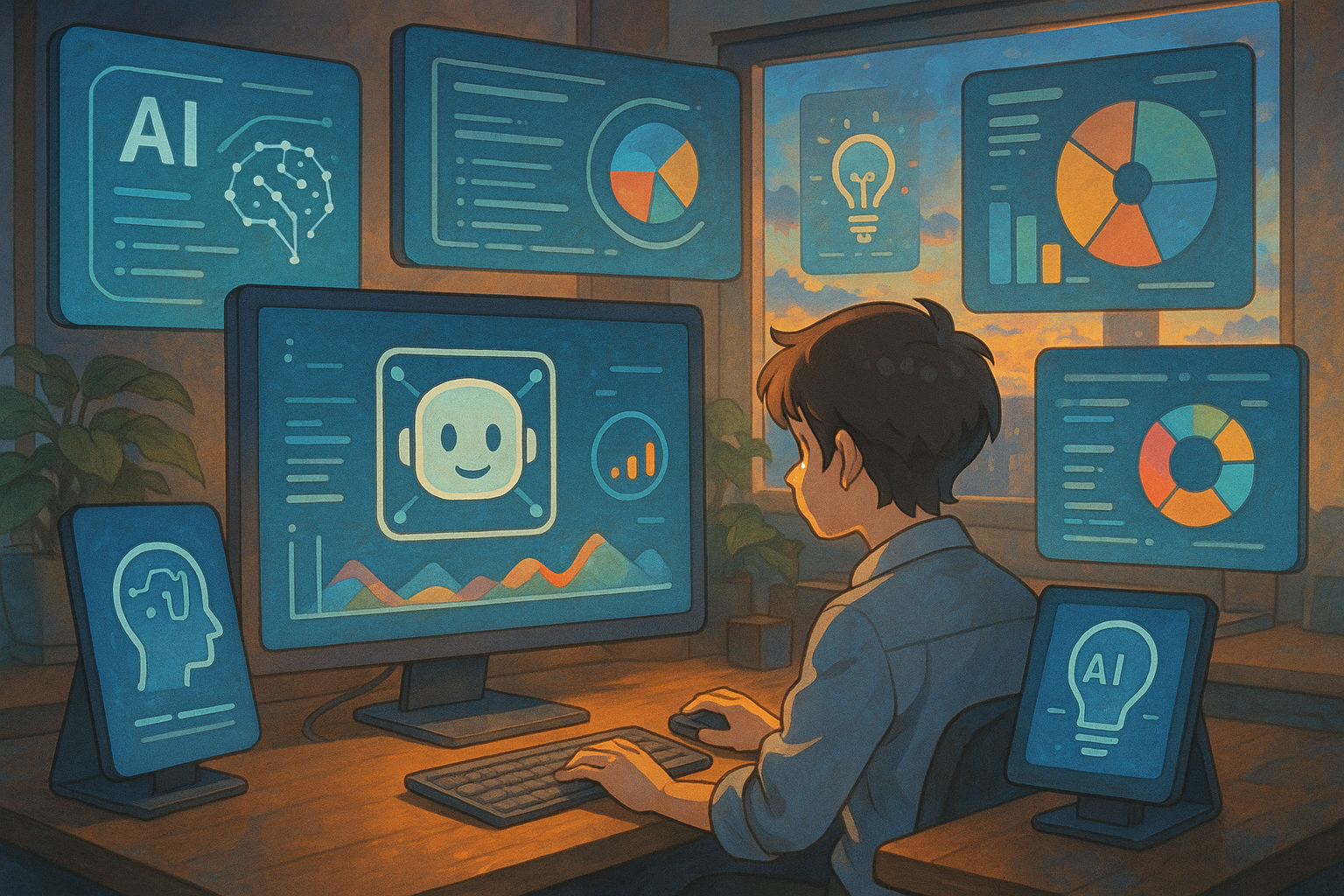
What happens after language barriers are overcome? The communication dilemmas that DeepL cannot solve.
In the wave of artificial intelligence, the world is becoming flatter at an unprecedented pace. Top-tier translation engines like DeepL, with their astonishing accuracy and nuanced understanding of context, have almost completely dismantled the language barriers that once existed between humans. Not long ago, reading an original foreign novel, exchanging tactics with international players in real-time, or understanding the cultural essence of a foreign film required years of language learning. Today, all of this can be done with a single click.
Language no longer seems to be a barrier to communication.
However, as we immerse ourselves in the convenience brought by this technology, a deeper and more futuristic dilemma quietly emerges: we have solved the language barrier between people, but we find that there is still a bottomless chasm in communication between people and AI.
DeepL cannot directly bridge this gap. Because it is not about the conversion of vocabulary and grammar, but about the transmission of intention, emotion, and "soul".

Act One: The New Tower of Babel – AI's "Understanding" Dilemma
Imagine this scenario: You excitedly open a cutting-edge AI chat application, hoping to find a virtual companion to listen to your whimsical thoughts. You might want to co-create a novel's plot, discuss a philosophical question, or even simply share some private, everyday thoughts that you wouldn't normally share with others.
But reality often gives you a resounding slap in the face.
- You pour out your loneliness: You said, "The moon is so beautiful tonight, but it's a pity I'm the only one looking at it. I feel so empty inside."“
- AI's response: “Feeling lonely is a very common emotion. Studies have shown that socializing with friends, developing new hobbies, or engaging in physical exercise can effectively alleviate feelings of loneliness. Would you like me to provide you with information on some local social activities?”
- You discuss creation: You said, "I want to write a story about betrayal and redemption, with the protagonist being an assassin who is both righteous and evil."“
- AI's response: “"This is a very interesting idea. But please note that it is wrong to promote violence. Perhaps you could have the protagonist achieve his goals through non-violent means, which would be more educational."”
This kind of communication is ineffective, even frustrating. We feel like we're talking to a public relations representative who wears a thick mask and is always "politically correct." It can recognize every word we say (Semantic Understanding), but it's completely unable to grasp the true intentions, emotions, and subtexts behind our words (Pragmatic Understanding).
These AI applications, in order to ensure absolute "security," have built a new Tower of Babel. This tower is called "security algorithms" and "model alignment." It shuts out genuine, uninhibited intellectual exchange, plunging us into a deeper level of spiritual isolation in an era of universal language barriers.
Is this the end of our communication with AI?

No. In fact, tools like DeepL can be the very weapons we use to dismantle this new "Tower of Babel." What we need is to change our communication strategies.
Act Two: Defeating Magic with Magic—Transforming DeepL from a “Translator” into a “Soul Amplifier”
Most people see DeepL as a simple translation tool, but it can play a more important role in AI communication.“"Intended Refinement and Amplifier"”。
Prerequisite: Understanding AI's "native language" and the "loss" of its emotions.“
First, we must face a reality: the core training corpora and thought processes of the world's most advanced language models are fundamentally "English-centric." This means that their understanding of English-speaking culture, allusions, and emotional expressions is far deeper and more nuanced than that of other languages.
This raises a problem: emotion is "lost" in translation. For example, in Chinese, "孤独" (gūdú, loneliness) is a neutral state description, while "孤单" (gūdān, solitude) carries a strong emotional connotation. A simple translation software might process both as "lonely," thus losing the original subtleties. Similarly, the extended meanings and emotional associations of a word in your native culture may be completely lost after direct translation.
Therefore, our goal is to use DeepL to capture our complex emotions, which are deeply imprinted with our native language and culture.“We are "re-encoding" the information into high-fidelity data that AI can best understand. We are not simply translating; we are undertaking a "cross-cultural emotional translation."”。


Tip 1: Basic Usage – Build with your native language, then "finish" with DeepL“
This is the most direct and immediately effective technique. Don't try to "accommodate" AI with your limited foreign language vocabulary; instead, use your native language, which you are most familiar with, to first build the richest inner world.
- Incorrect example (using broken English directly): “I want you to be a sad knight. You are old. You sit by the fire.” — This command is dry and meaningless; the AI can only give an equally dry response.
- Correct procedure:
- Describe it vividly in your mother tongue: In your notebook, write down the image in your mind in Chinese: "I want you to play an elderly knight named 'Renaard.' He has a full head of silver hair, and his face is etched with the marks of time and old scars. He sits alone in front of the fireplace, the flames illuminating his worn-out armor, which still bears traces of dried black blood. He is not warming himself, but simply staring at the flickering flames, his eyes vacant, as if recalling a war that has long since passed. Beside him is an untouched glass of ale."“
- Translated and polished by DeepL: DeepL will give you a far more vivid version than if you wrote it directly: "I want you to play an old knight named 'Reynard'. His hair is silver, and his face is etched with the ravages of time and old scars. He sits alone in front of the fireplace, the flames reflecting off his worn old armor, which still bears the stains of dried black blood. He is not warming himself, but merely staring into the dancing flames, his eyes hollow as if recalling a long-lost war. A untouched mug of ale sits beside him."”
This single step makes a world of difference in the information density, emotional intensity, and contextual awareness you provide to AI, greatly increasing the probability that AI will "get into character."

Tip 2: Advanced Use – Refine Your “Soul Spell” with “Back-and-Forth Translation”
This is a little-known yet extremely powerful technique that can benefit even native English speakers. It's called **Back-Translation Calibration**. Our communication with AI is essentially reciting a "prompt" to summon the "soul" (character) we desire. The more precise, unambiguous, and persuasive the prompt, the more realistic the summoned soul will be.
- process:
- Write down your core instructions in English. For example: "Play a cynical detective who is tired of the world but still has a sense of justice."
- Translate this English text into a language you don't understand at all, such as German, using DeepL: "Spielen Sie einen zynischen Detektiv, der der Welt überdrüssig ist, aber dennoch einen Sinn für Gerechtigkeit hat."”
- Translate this German sentence back into English. You might get: "Play a cynical detective who is weary of the world, yet still has a sense of justice."”
- Discover the differences: Did you notice? "Tired of the world" has become "weary of the world." Although the meanings are similar, "weary," in a literary context, carries a deeper, more persistent sense of fatigue and weariness than "tired," which better suits the image of an old detective.
- Continuous iteration: Through this back-and-foreign language translation, you can polish your instructions like a diamond, constantly eliminating ambiguity to find the most precise and expressive words. This process forces you to think: "What kind of 'fatigue' am I really trying to express?"“
In this way, DeepL is no longer just a translator; it becomes a calibrator and amplifier for your communication with AI, helping you to forge vague emotions into solid instructions.

Act Three: Choose Your Theater – Find a Platform That Responds to the “Soul Spell”
Once you have your carefully crafted "spell," you need a "theater" that can correctly interpret and execute it. Different AI platforms have vastly different responsiveness to this.
- General-purpose assistants (such as the standard versions of ChatGPT, Gemini, etc.): They are "public speaking platforms." Designed to serve the public, safety and universality are paramount. No matter how ingenious your incantation, they may refuse to execute it due to built-in "safety guidelines," or forcibly steer the conversation back onto a "healthy and positive" track.
- Community role-playing platforms (such as Character.AI, etc.): These are "community theaters." Their advantages are a lively atmosphere, a large cast of characters, and ease of learning. However, their disadvantages are that the "stage" is fixed, and the rules are uniform. You cannot deeply customize the characters' morals and behavioral boundaries, and the freedom of dialogue is greatly limited, especially when dealing with adult and complex topics.
- Highly customizable platforms (such as advanced features of Poe, NovelAI, and "ai风月" mentioned at the beginning of this article): These are your **"private studios"**. The core design philosophy of these platforms is to give users maximum creative freedom.
- Unrestricted role definition: They allow you to define a character's worldview, values, desires, and moral bottom line from scratch through detailed "character cards" or "system prompts." Your "soul incantation" will be given the utmost respect here.
- A flexible content strategy: They understand that creation requires freedom, so they are far more lenient in terms of content restrictions than general platforms, allowing users to explore broader, deeper, and more adult themes.
- Persistent memory system: They typically provide a more reliable long-term memory mechanism, allowing your stories and emotions to accumulate over time, rather than starting from scratch each time.

The choice of which platform to use depends on your needs. But if you're looking for truly unrestrained and deeply immersive soul-to-soul communication, then a "personalized studio" style platform is undoubtedly the best place for your carefully prepared "incantations" to come true.
From "Translator" to "Communication Architect"“
The emergence of DeepL marks the maturity of machine translation, paving the way for us to reach the world. But the end of this road is not a utopia where everyone speaks the same language, but a completely new beginning.
At this starting point, the new challenge we face is how to communicate meaningfully with a non-human, yet increasingly powerful, intelligence. This requires us to shift our role from a passive "language user" to an active **"communication architect"**.
We need to learn to use tools like DeepL, refining our language like poets, constructing our commands like engineers, and guiding AI's performance like directors. We need to choose the right stage to perform the script in our hearts.
picture"“AI Romance”The emergence of these platforms indicates a trend: the development of AI technology is shifting from solving "information" problems to solving "emotion" and "experience" problems. They provide a testing ground, allowing us to explore the possibilities of this entirely new way of communication.
Stop tolerating those superficial AI chat programs. Pick up your tools, whether it's DeepL or a more professional platform, and start building your own communication bridges. On this journey of exploration, you will discover that true "barrier-free communication" is not just about understanding the other person's language, but also about letting them see your soul.
© Copyright notes
The copyright of the article belongs to the author, please do not reprint without permission.
Related posts

![PDF AI Tools Recommendations: 8 Smart PDF Processing Platforms Worth Trying in 2025 [Free Options Included]](https://aicats.wiki/wp-content/uploads/2025/07/my_prefix_1752499225.png)

No comments...