What is NMT Neural Machine Translation? A Comprehensive Guide to AI Translation Technology Principles and Application Scenarios
NMT (Neural Machine Translation)In recent yearsAI-powered automatic translationThis mainstream technology, based on deep neural networks, significantly improves translation accuracy and fluency. This article provides a comprehensive analysis.The principles of NMT (such as encoder-decoder, attention mechanism and other core technologies), a comparison of mainstream AI translation engines, practical application scenarios (such as cross-border e-commerce, intelligent customer service, medical care, etc.), key selection points and challenges.This provides businesses and individuals with a comprehensive and practical guide to AI translation technology. It is suitable for all types of users interested in digital and globalized information dissemination.
What is NMT? A Core Explanation of AI Translation Technology
Basic Definition and Development History of NMT
Neural Machine TranslationNeural Machine Translation (NMT) is an automatic translation technology based on artificial neural network structures, and it has now become a core solution in the field of AI translation. Compared with earlier rule-based systems and statistical machine translation (SMT), NMT performs better in terms of accuracy and fluency.
- Time of appearanceIn 2014, tech giants such as Google, Microsoft, and Baidu released the NMT translation engine.
- Technological leapIt relies on deep learning models to understand the complex semantic mapping relationship between source and target languages.
Detailed introduction to machine translation technology
Basic working principle of NMT
NMT uses an Encoder-Decoder structure.End-to-end training of neural networks enables fully automated learning of text semantics.
| step | illustrate |
|---|---|
| Input encoding | Source language text converted into vector representation |
| Context capture | Automatically learn text context and language |
| Output Decoding | The decoder restores the target language sentence. |
| Verification optimization | Attention mechanisms improve outcome quality |

NMT's technical advantages over SMT
- Stronger contextual understandingNot only can it be used to analyze each word, but it can also help to grasp the overall meaning of the sentence.
- High degree of naturalnessThe output should closely resemble native language expression habits.
- Model self-learning: Continuous optimization to adapt to new corpora.
A list of mainstream AI translation engine solutions and tools
Comparison of mainstream AI translation engines
Numerous AI translation services based on NMT are emerging. Here is a brief comparison of several mainstream products:
| Products/Services | Technology type | Key Highlights | Supported languages | Official website |
|---|---|---|---|---|
| Google Translate | NMT | High accuracy, convenient API | 100+ | Google Translate |
| DeepL | NMT | Authentic expression, literary works preferred | 30+ | DeepL |
| Baidu Translate | NMT | Excellent Chinese-English translation | 200+ | Baidu Translate |
| ECI Link | NMT+AI | Enterprise-level management & quality inspection | 30+ | ECI Link |
| iFlytek Translation | NMT | Real-time speech recognition and translation | 80+ | iFlytek Translation |
All products are based on NMT.The differentiation lies in features such as text type, management functions, and cloud deployment.
AI Translation Tool Application Trends
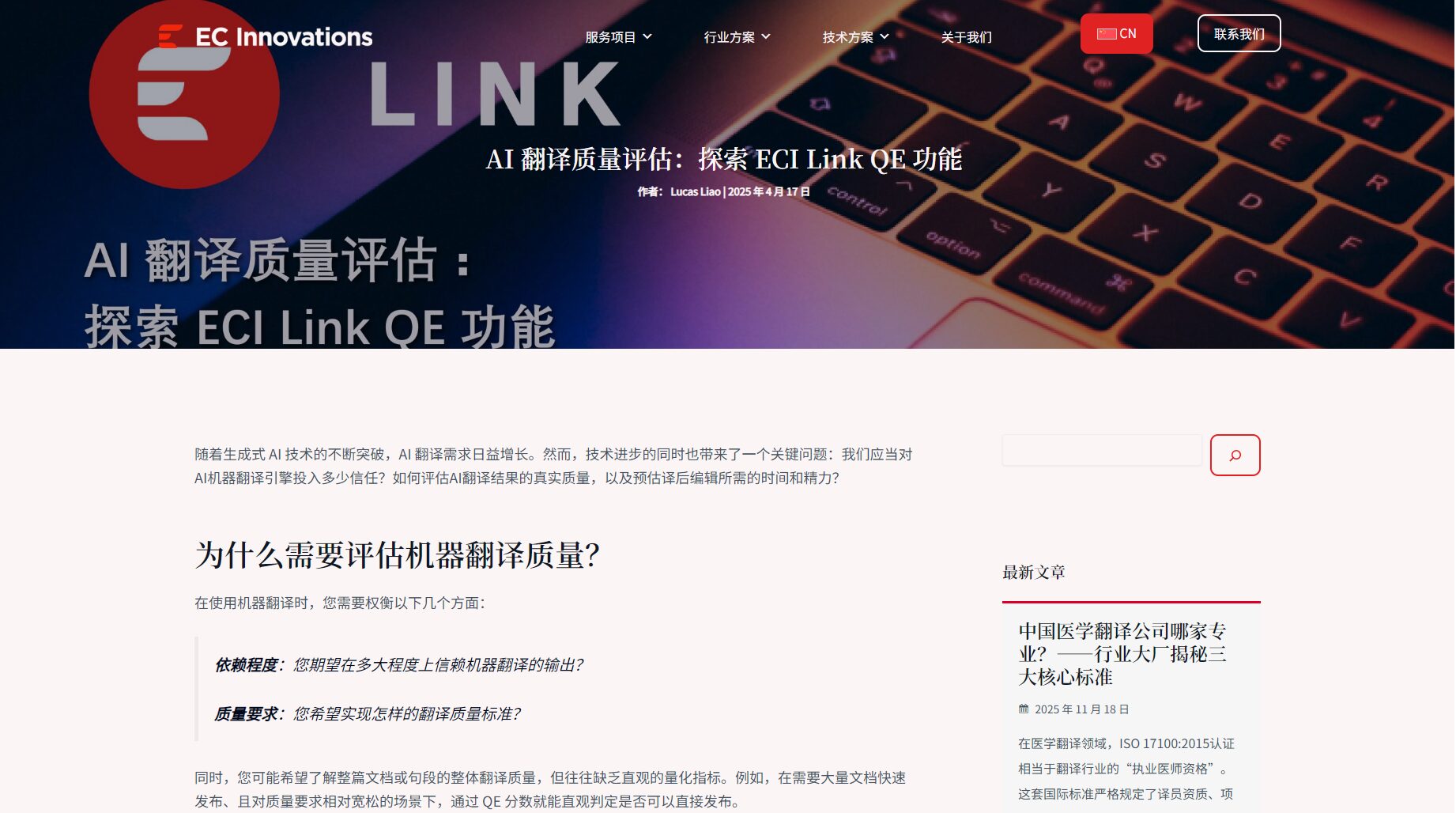
- Excellent API access capabilitiesIt facilitates integration into websites/apps to enable automatic switching of multilingual content.
- Batch translation and writing assistanceSuitable for businesses and information dissemination.
- Quality assessment and post-editing capabilities: Integrating manual editing processes improves the quality of the finished product.Introduction to AI Translation Quality Assessment
Detailed Analysis of NMT Technology Principles
Encoder-decoder architecture
EncoderEncode the input text into a semantic vector while preserving the original meaning.
DecoderUsing semantic vectors, target language sentences are generated step by step.
Attention Mechanism
Attention mechanismIt allows NMT to better pinpoint key information in the source text, greatly improving translation quality.
| Technology Name | Function Description | Application effect |
|---|---|---|
| Bidirectional encoding | Considering the context | Improve the ability to translate complex sentences |
| Sub-word segmentation | Decomposing uncommon words | Better handling of unknown words |
| Large-scale corpus training | Learning from massive datasets | Generalization and accuracy improvement |
| Multilingual model | A set that supports multiple languages | Enterprises reduce costs and improve efficiency |
Continuous learning and fine-tuning
The NMT model supports continuous fine-tuning, targeted industry corpora, and domain-specific optimization of customized terminology databases, adapting to professional scenarios such as healthcare, law, and e-commerce.
NMT Technology Application Scenarios Overview
Cross-border e-commerce and content localization
Batch translation of product details, reviews, and multilingual help center on cross-border platforms.NMT solutions can:
- Low-cost multilingual coverage
- Improve user experience and increase responsiveness
- Combining manual post-editing achieves both quality and efficiency.
Intelligent customer service and real-time voice translation
AI Customer Service RobotNMT is widely used to unify multilingual work orders and provide real-time voice Q&A responses.

refer to:AI Customer Service Management Tool Case Study
International Conferences and Distance Education
- Live captions and simultaneous interpretation for meetings
- Barrier-free communication in international education courses
Vertical industries such as healthcare, law, and new energy
Standard translations are automatically generated based on NMT+ professional corpus.This reduces labor costs.
- Supports automatic translation of drug instructions, contracts, and agreements.
- Continuous fine-tuning to improve the accuracy of technical terminology
Multilingual websites & apps launched by companies going global
Rapidly implement NMT technologyMultilingual websites and apps launchedEfficient global operations.Localization details reference

NMT Implementation Selection and Practical Challenges
Considerations when selecting NMT
- Industry adaptability: Breadth of coverage for customized corpora and domain models.
- Data security and complianceWhether it complies with regulations regarding the protection of corporate/individual privacy.
- Edit after supportIt facilitates human-computer interaction and refinement.
- API friendlyIt facilitates integration into existing systems and large-scale operations.
| Evaluation criteria | Core Explanation | Recommended tools |
|---|---|---|
| Industry support capabilities | Customized corpus scenarios | DeepL, Baidu Translate, ECI Link |
| Quality monitoring and feedback | Automatic scoring and proofreading | ECI Link, Google Translate |
| Security and Privacy | Localized deployment | Baidu Translate Enterprise Edition, ECI Link |
| API usability | Integration and batch-friendly | DeepL, Google Translate |
Current challenges facing NMT
- Difficulty in aligning industry terminologyThe professional content still needs to be manually reviewed and confirmed.
- Cultural and Humor TranslationAI struggles to understand deep cultural nuances and humor.
- New words and internet slang are adapted slowly.It requires continuous addition of data and dynamic model optimization.
Conclusion
As AI and NMT technologies continue to mature, AI translation technology is profoundly transforming various industries, including overseas expansion, e-commerce, intelligent customer service, and medical and legal services. Choosing the right NMT solution and combining it with the strengths of both humans and machines will be essential for businesses to accelerate globalization in the digital economy era.In the future, NMT will be smarter and more human-centered, helping to make communication barrier-free around the world.
© Copyright notes
The copyright of the article belongs to the author, please do not reprint without permission.
Related posts


No comments...