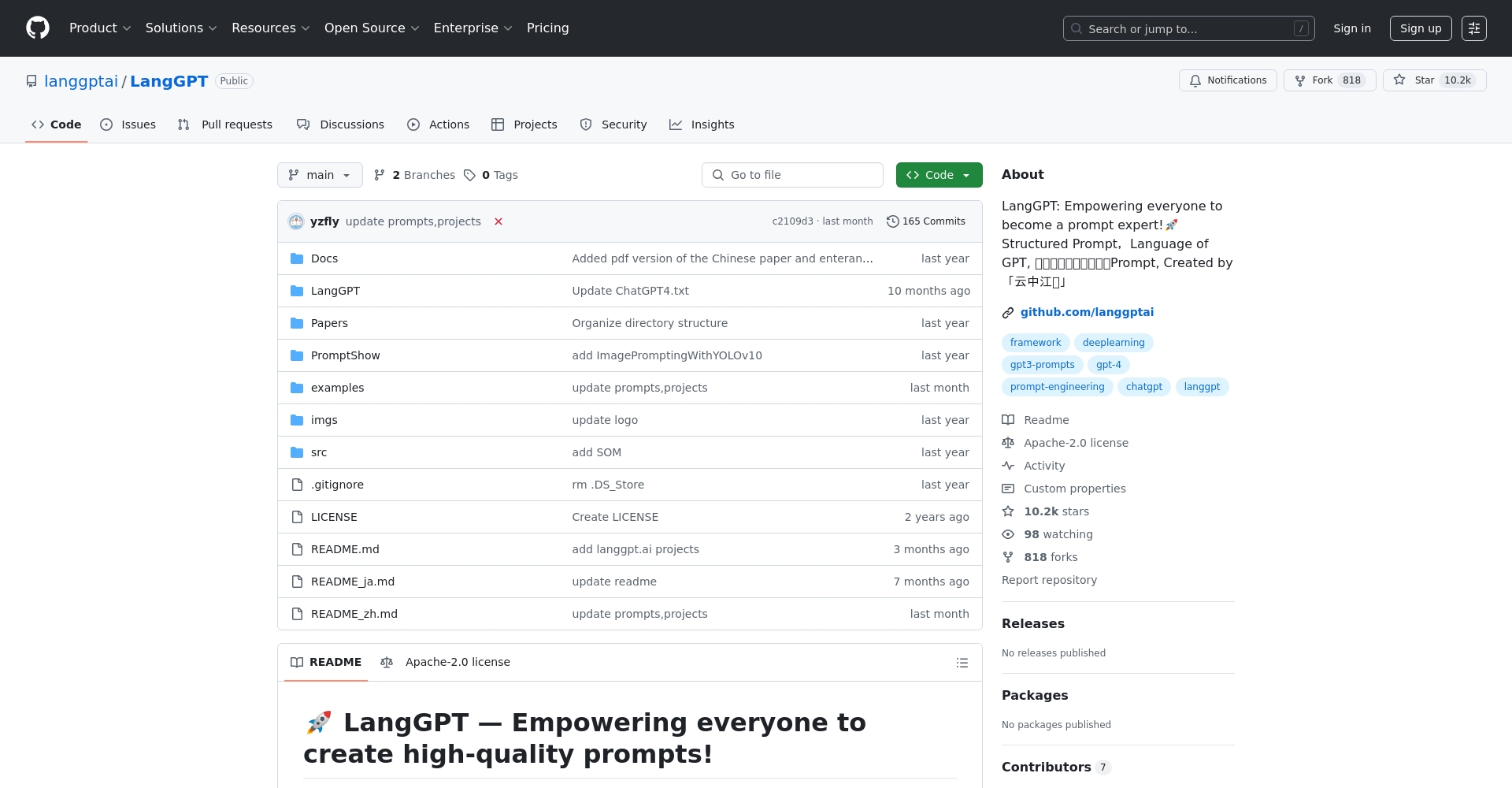
LangGPTAs an innovator in the field of AI prompts, this platform significantly lowers the barrier to entry for high-quality prompt engineering through its modular and structured approach.Open source and free,支持多语种、多场景复用,辅助工具丰富,并拥有活跃社区与案例库。无论是AI开发者、内容Creators还是教育者,都能通过LangGPT: A Quick Start Guide to Significantly Improving AI Interaction QualityHigh-quality structured prompts are becoming central to AI productivity, and LangGPT is one of the best assistants for entering this new era.
In-depth report on LangGPT platform: a revolutionary AI prompting tool for the new era.
Amidst the rapid development of AI prompt engineering in 2023, LangGPT quickly gained widespread attention from global developers and AI users with its structured and modular innovative approach. This article will provide a comprehensive overview of LangGPT's main functions, pricing and solutions, usage methods, target audience, and its impact on the AI prompt engineering ecosystem, presented in a news report format. For detailed references and tools, please visit:https://github.com/langgptai/LangGPT。
Introduction and Development History of LangGPT
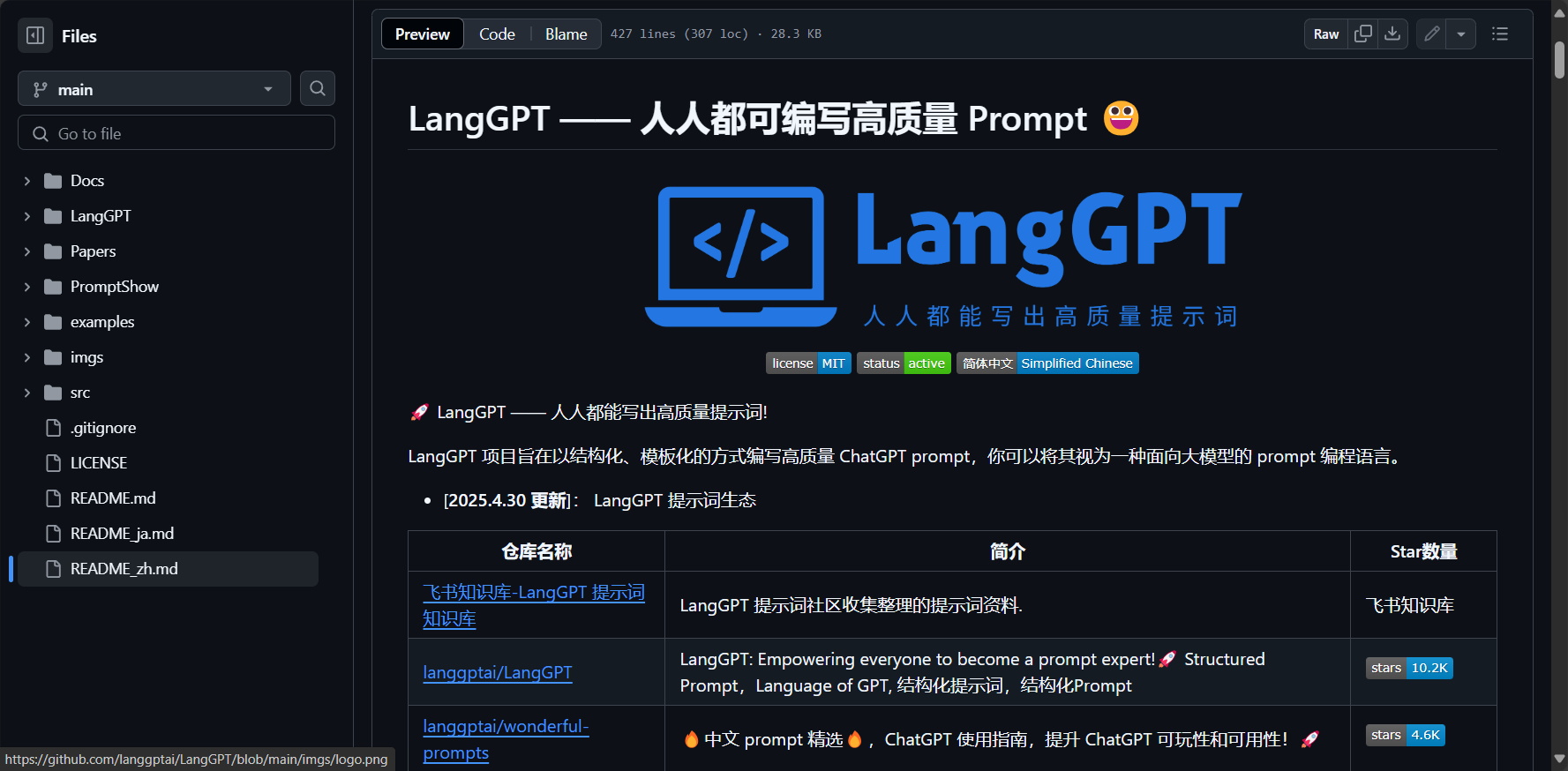
With the popularization of large-scale AI models (LLM), writing high-quality AI prompts has become a core element determining the output effect. LangGPT was originally proposed by Chinese developer Yunzhong Jiangshu in 2023 and open-sourced on GitHub. LangGPT (Language for GPT), or "Structured Prompts," is dedicated to helping users quickly and efficiently write reusable, high-quality AI prompts. The underlying theoretical basis is a modular and standardized methodology for writing prompt words, with the goal of making AI prompt engineering fully "programmed language-based".
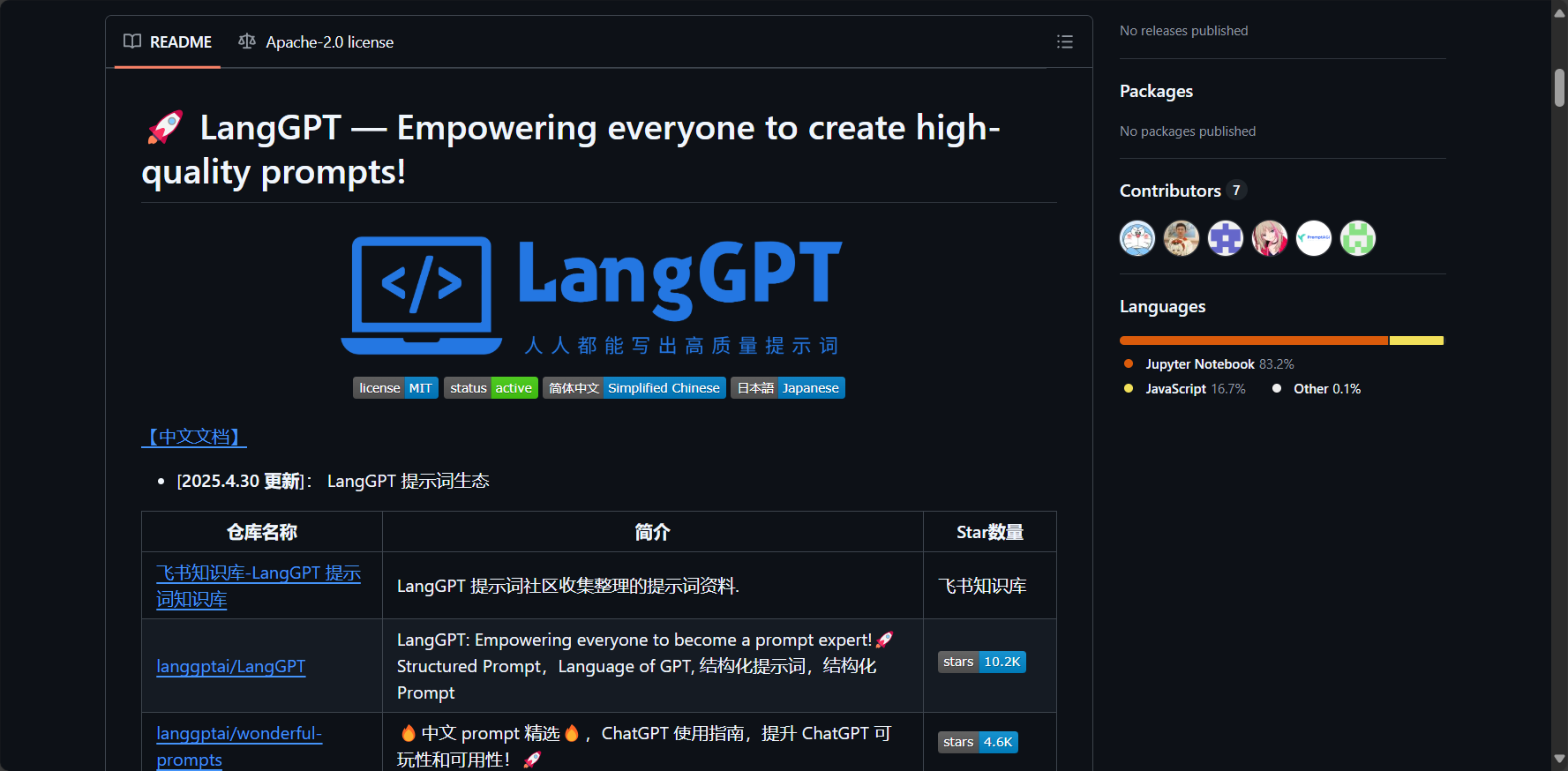
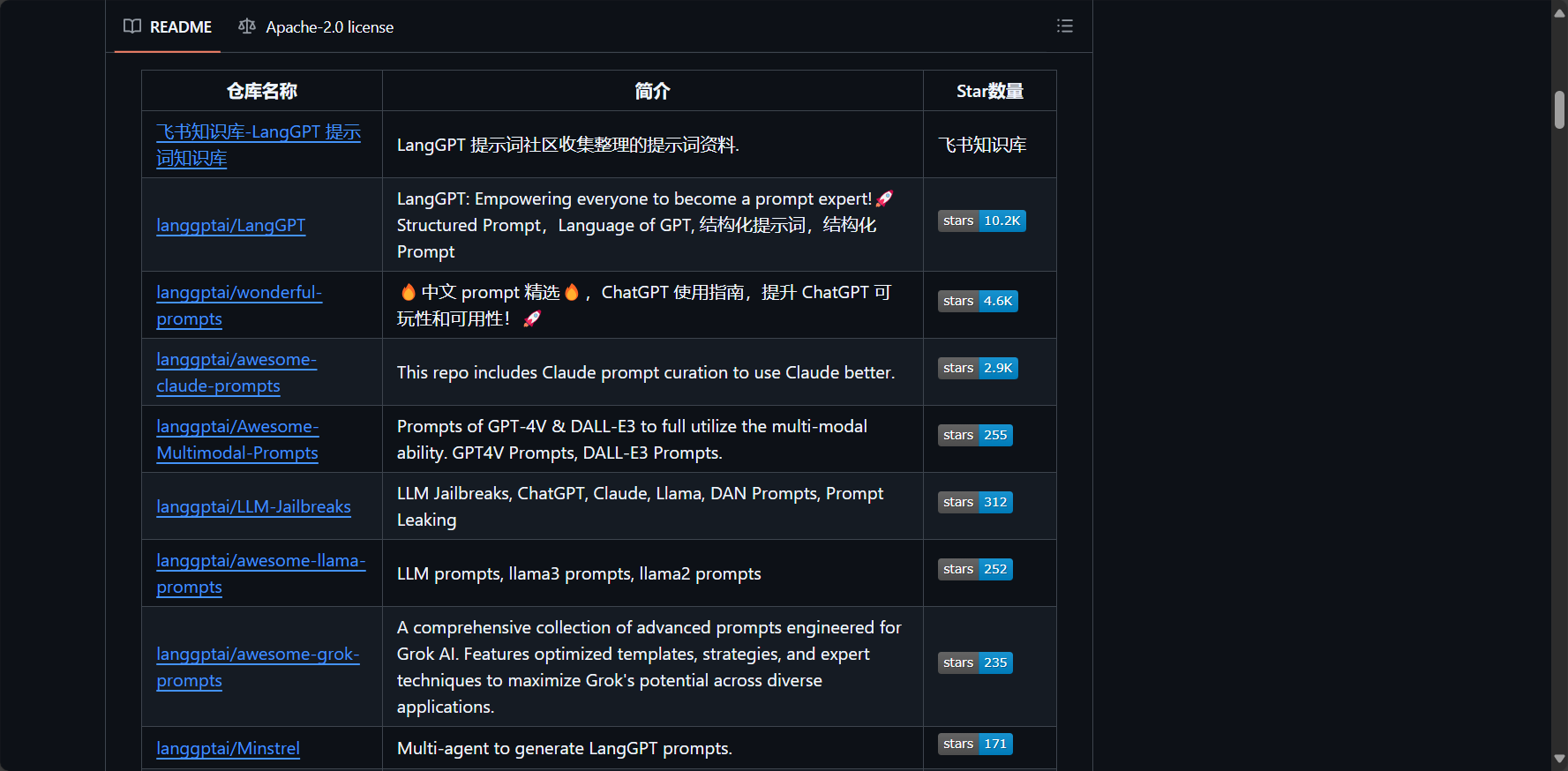
Currently, LangGPT has been adopted by mainstream AI model platforms such as Baidu, ByteDance, and Huawei, and has developed into one of the largest and most dynamic AI prompting engineering communities in China. For detailed information, please visit the LangGPT project homepage.
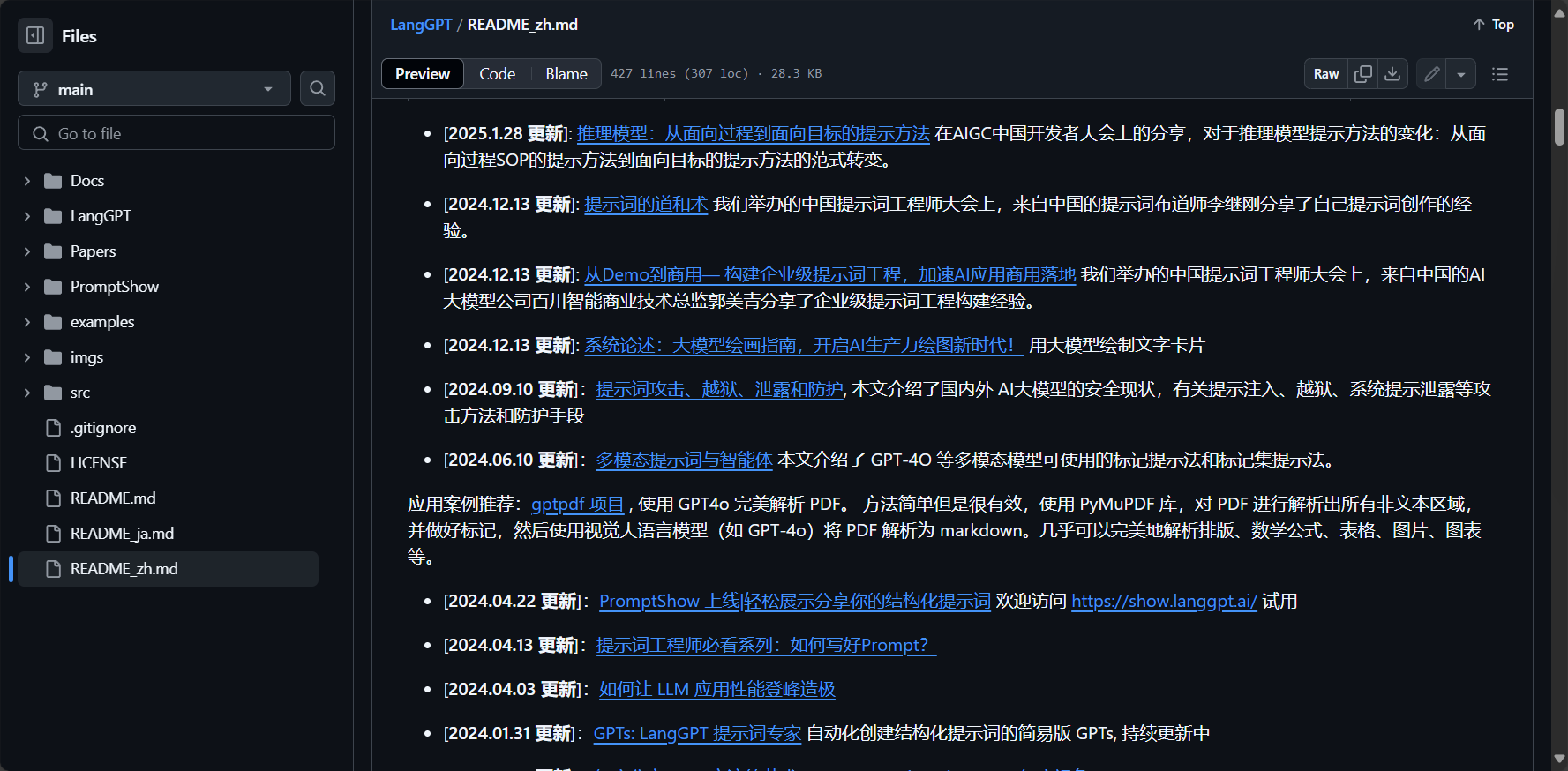
Image/Screenshot of LangGPT's official homepage
Main functions of LangGPT
1. Structured prompt word design
– Two-layer structure template: LangGPT breaks down prompts into modules (similar to "classes" in programming languages) and elements (similar to "properties" and "methods"). – Formatting specifications: Users can define elements such as role-playing, goals, steps, and scenarios through structured formats (such as Markdown, JSON, etc.), making them easy to reuse and extend. – AI-powered automatic understanding and citation: Large models can identify module and title structures, enabling accurate content understanding and expression.
2. Supports custom variables and templates.
LangGPT introduces a variable and reference mechanism, similar to function parameters in programming languages, which supports content referencing and modification, greatly improving the flexibility of suggestion construction. – Provides role templates, command templates, process templates, etc., simplifying the instruction creation process for both novice and advanced users.
3. Prompts for automatic generation and optimization of auxiliary tools
– With supporting tools such as LangGPT Assistant, users only need to fill in the project content to automatically generate high-quality prompts, allowing even those unfamiliar with Prompt to write excellent AI dialogue guidance. – It can be integrated into mainstream large model platforms such as ChatGPT and GPT-4.
– Through structured segmentation, it supports the creation and translation of multilingual prompts, making it easy to apply to users worldwide.
5. A comprehensive community and case study database LangGPT has a rich user community that continuously collects and shares real and effective AI prompt command examples, realizing the "open source circulation" of prompt commands.
Comparison of main functions
| Features | LangGPT | Traditional prompts | |————|————————–|———————| | Structured Design | Supports two-tier modular structure | Does not support cluttered content | | Variable referencing | Supported, implemented via Markdown/JSON, etc. | Generally not supported | | Reusability | High, modular reusability | Low, requires manual copying and modification | | Automatic command generation | Supports quick command writing with auxiliary tools | Not supported | | Scene adaptation | Multilingual, multi-scene | Manual conversion required | | Community Case Library | Available, updated regularly with best practices | Generally unavailable, and updates are slow |
For more feature information, please visit the LangGPT GitHub documentation.
Interact with a vast array of 2D and 3D characters and experience truly unlimited AI role-playing dialogue. Join now! New users receive 6000 points upon login!
LangGPT is an open-source and free tool, and its complete source code, template library, and usage tutorials are available on the GitHub project homepage. Users are free to:
– Download and install (supports local/cloud platform/integrated development environment) – Browse and participate in community case studies – Participate in the secondary development of official documentation and code.
LangGPT is not a subscription-based or commercially charged product; it is suitable for widespread free use by individuals, businesses, and educational institutions.
| Solution/Purpose | Cost | Usage Method | | Open source code | Free | Download from GitHub | | Personal or enterprise applications | Free | Self-deployment/integration on-premises | | Community/Learning Exchange | Free | Structured Tips and Examples for Contributions and Requests |
Note: For some enterprises requiring commercial customization, cooperation with the LangGPT community/development team is available (subject to community announcements for details). For detailed plans and pricing information, please visit the LangGPT official homepage or the LangGPT official community.
Image/Deployment according to instructions
How to use LangGPT
1. Quick Start Guide
Step 1 – Obtain and Install – Open the GitHub project page – Download or clone the repository – Read the README.md document and deploy according to the instructions.
Step 2 – First Writing Experience – Choose an existing template (such as role-playing, writing assistant, etc.) – Fill in the required objectives, constraints, and output format using a structured approach. – Submit the AI-provided instruction syntax as input to large models such as ChatGPT.
Image/Update Overview
Step 3 – Optimization and Reuse – Referencing community case studies, fine-tune the module content based on actual results. – Reduce repetitive work by leveraging variable referencing and module reuse capabilities.
Example: LangGPT Structured Prompt
# Profile You are a professional English scientific paper writing assistant.
# Goal It helps users efficiently write well-structured and logically rigorous abstracts for scientific papers.
# Constraint Abstracts should be limited to 500 words, and colloquial language is prohibited; only academic terminology should be used.
# Example Input: Paper Topic and Key Points Output: Standard English summary
Ultimately, only module adjustments are needed to apply it to other similar scenarios. For detailed usage instructions, please refer to the GitHub tutorials.
Image/Open Source AI Tools
—
Who is LangGPT suitable for?
LangGPT significantly lowers the barrier to entry for tooltips engineering, making it suitable for the following groups:
– AI application developers: can quickly design and share high-quality prompts to improve product interaction experience and the controllability of AI output. – Content creators and writers: Utilize structured templates to create writing assistants, copywriting assistants, etc., to achieve efficient content production. – AI beginners and education: Even without an AI background, you can master large-scale model dialogue, question answering, writing and other applications through modular templates. - Product managers and enterprise in-house deployers: can customize and reuse various instruction templates as needed to form an enterprise knowledge base. – Prompt Engineer: A tool platform for developing standardized prompts, manuals, guidelines, and community practices.
| Applicable Roles | Examples of Useful Scenarios | Advantages of Structured Design | |———-|——————-|—————–| | Developers | Intelligent Question Answering, Automatic Summarization, AI Agent | Templated Reuse, Reduced Maintenance | | Copywriting/Writer | Novel writing, academic paper writing, dialogue generation | Clear constraints, diverse styles | | Teachers/Students | AI-Assisted Teaching and Writing Training | Easy to Use, Flexible Applications | | Enterprise Team | Intelligent Customer Service, Business Process Automation | Highly Customizable, Convenient Internal Communication |
—
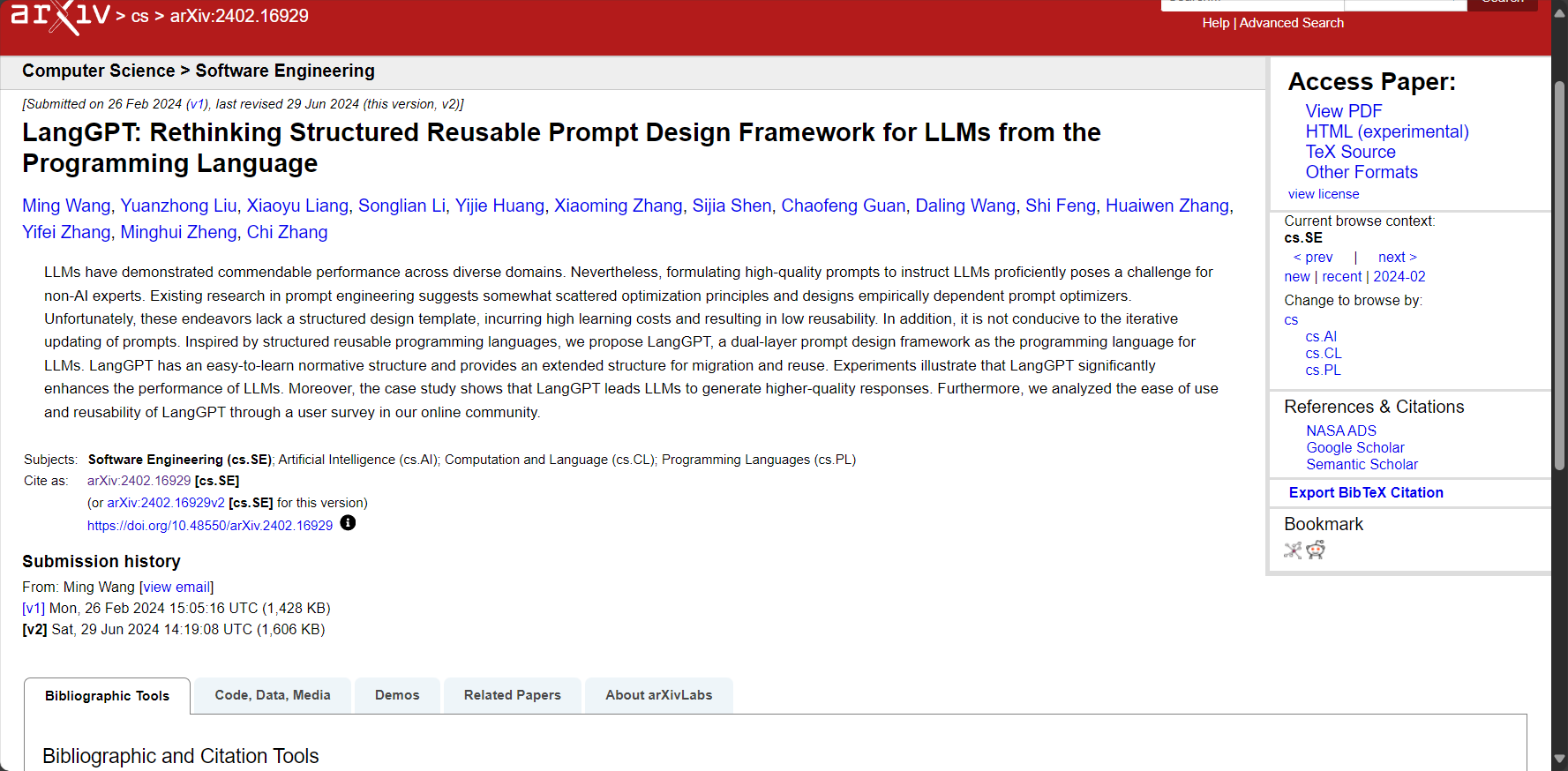
Image/Related Paper
LangGPT Community and Ecosystem
1. Community-driven and sharing mechanism LangGPT has grown into a massive community with over 10,000 stars on GitHub and hundreds of active contributors. – Continuously submit the best AI prompt command case library to quickly respond to new scenario requirements. – Open Q&A and discussion forums to support the growth of both beginners and experts.
2. Collaboration and Implementation Cases – Top domestic large model manufacturers such as Baidu and Huawei have integrated LangGPT structured templates into their own platforms. – Independent optimizations based on LangGPT are being implemented in various sectors, including education and fintech.promptin stock.
3. Continuous iteration and upgrades – The official website regularly releases version iterations of Markdown, JSON, and other structures, supporting more modules and writing templates. – We welcome developers worldwide to contribute features and case studies to promote the standardization of AI prompting engineering.
For more information and the latest version, please visit the LangGPT project homepage. If you aspire to write high-quality, systematic, and reusable AI prompts, LangGPT is undoubtedly one of your best assistants for stepping into the new era of AI.
Interact with a vast array of 2D and 3D characters and experience truly unlimited AI role-playing dialogue. Join now! New users receive 6000 points upon login!
LangGPT浏览人数已经达到83,如你需要查询该站的相关权重信息,可以点击"5118 Data""Aizhan Data""Chinaz data""Based on current website data, we recommend using Aizhan data as a reference. More website value assessment factors include:"LangGPTAccess speed, search engine indexing and volume, user experience, etc.; of course, to evaluate the value of a website, the most important thing is to base it on your own needs and requirements, and some specific data will need to be obtained from [research institutions/resources].LangGPTWe will negotiate with the website owner to provide information such as the website's IP addresses, page views (PV), and bounce rate.
aboutLangGPTSpecial Announcement
This site's AI-powered navigation is provided by Miao.LangGPTAll external links are sourced from the internet, and their accuracy and completeness are not guaranteed. Furthermore, AI Miao Navigation does not have actual control over the content of these external links. As of 3:50 PM on July 16, 2025, the content on this webpage was compliant and legal. If any content on the webpage becomes illegal in the future, you can directly contact the website administrator for deletion. AI Miao Navigation assumes no responsibility.